
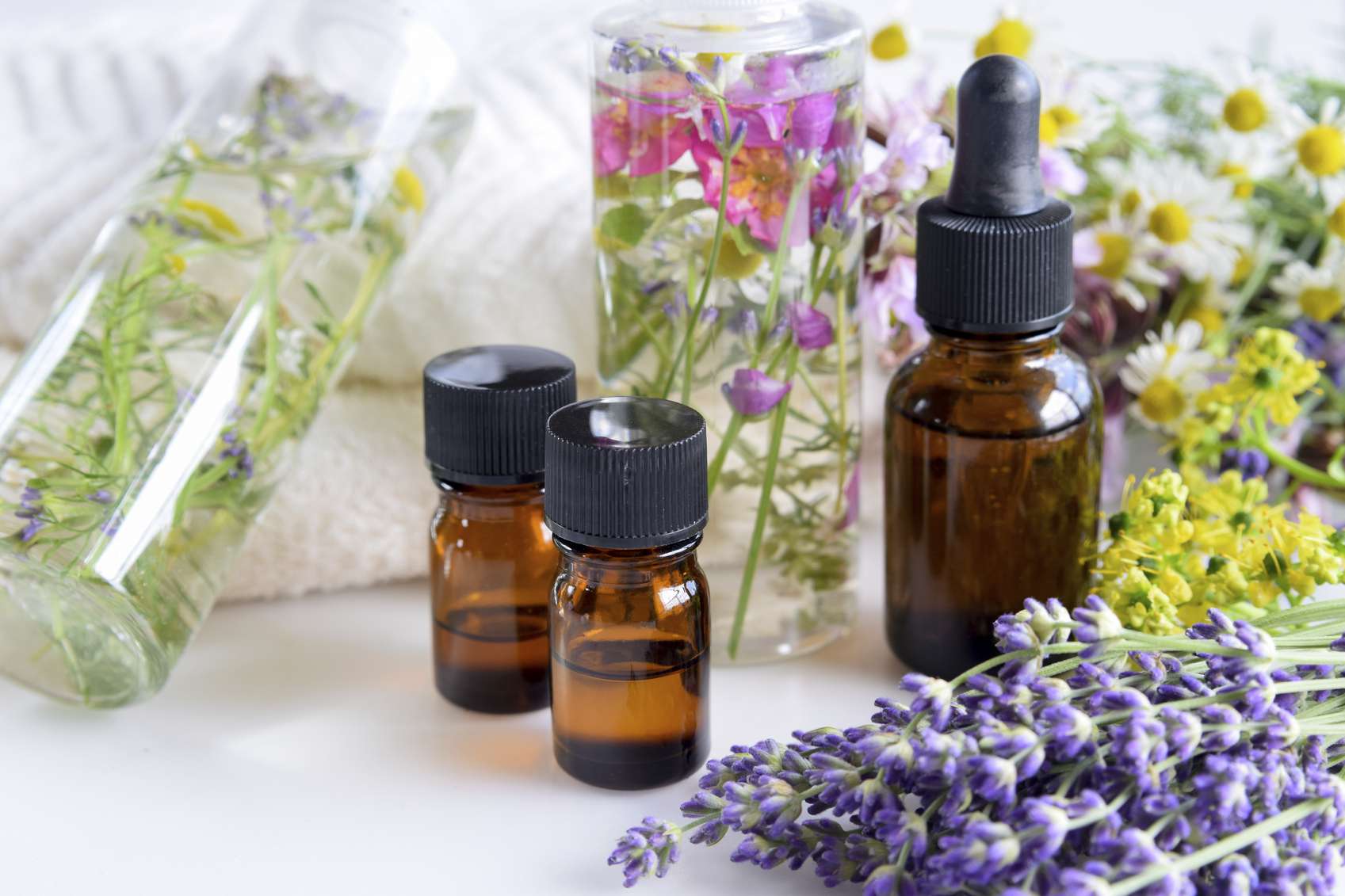
An essential oil is a concentrated hydrophobic liquid containing volatile (easily evaporated at normal temperatures) chemical compounds from plants. Essential oils are also known as volatile oils, ethereal oils, aetherolea, or simply as the oil of the plant from which they were extracted, such as oil of clove. An essential oil is "essential" in the sense that it contains the "essence of" the plant's fragrance—the characteristic fragrance of the plant from which it is derived. The term "essential" used here does not mean indispensable or usable by the human body, as with the terms essential amino acid or essential fatty acid, which are so called because they are nutritionally required by a given living organism.
Essential oils are generally extracted by distillation, often by using steam. Other processes include expression, solvent extraction, sfumatura, absolute oil extraction, resin tapping, wax embedding, and cold pressing. They are used in perfumes, cosmetics, soaps and other products, for flavoring food and drink, and for adding scents to incense and household cleaning products. Essential oils are often used for aromatherapy, a form of alternative medicine in which healing effects are ascribed to aromatic compounds. Aromatherapy may be useful to induce relaxation, but there is not sufficient evidence that essential oils can effectively treat any condition.
Improper use of essential oils may cause harm including allergic reactions and skin irritation, and children may be particularly susceptible to the toxic effects of improper use
Essential oils have been used in folk medicine throughout history. The earliest recorded mention of the techniques and methods used to produce essential oils is believed to be that of Ibn al-Baitar (1188–1248), an Al-Andalusian (Muslim Spain) physician, pharmacist and chemist. Rather than refer to essential oils themselves, modern works typically discuss specific chemical compounds which the essential oils are composed of, such as referring to methyl salicylate rather than "oil of wintergreen". Interest in essential oils has revived in recent decades with the popularity of aromatherapy, a branch of alternative medicine that uses essential oils and other aromatic compounds. Oils are volatilized, diluted in a carrier oil and used in massage, diffused in the air by a nebulizer, heated over a candle flame, or burned as incense. Medical applications proposed by those who sell medicinal oils range from skin treatments to remedies for cancer and often are based solely on historical accounts of use of essential oils for these purposes. Claims for the efficacy of medical treatments, and treatment of cancers in particular, are now subject to regulation in most countries.
Note:
Iran Galbanum Oil Company only uses this method(Steam Distillation) to produce Essential oils...
Most common essential oils such as lavender, peppermint, tea tree oil, patchouli, and eucalyptus are distilled. Raw plant material, consisting of the flowers, leaves, wood, bark, roots, seeds, or peel, is put into an alembic (distillation apparatus) over water. As the water is heated, the steam passes through the plant material, vaporizing the volatile compounds. The vapors flow through a coil, where they condense back to liquid, which is then collected in the receiving vessel. Most oils are distilled in a single process. One exception is ylang-ylang (Cananga odorata) which is purifed through a fractional distillation. The recondensed water is referred to as a hydrosol, hydrolat, herbal distillate, or plant water essence, which may be sold as another fragrant product. Hydrosols include rose water, lavender water, lemon balm, clary sage, and orange blossom water. The use of herbal distillates in cosmetics is increasing.
Steam distillation
is a special type of distillation (a separation process) for temperature sensitive materials like natural aromatic compounds. It once was a popular laboratory method for purification of organic compounds, but has become less common due to the proliferation of vacuum distillation. Steam distillation remains important in certain industrial sectors. Many organic compounds tend to decompose at high sustained temperatures. Separation by distillation at the normal (1 atmosphere) boiling points is not an option, so water or steam is introduced into the distillation apparatus. The water vapor carries small amounts of the vaporized compounds to the condensation flask, where the condensed liquid phase separates, allowing easy collection. This process effectively enables distillation at lower temperatures, reducing the deterioration of the desired products. If the substances to be distilled are very sensitive to heat, steam distillation may be applied under reduced pressure, thereby reducing the operating temperature further. After distillation the vapors are condensed. Usually the immediate product is a two-phase system of water and the organic distillate, allowing separation of the components by decantation, partitioning or other suitable methods.
Principle
When a mixture of two practically immiscible liquids is heated while being agitated to expose the surface of each liquid to the vapor phase, each constituent independently exerts its own vapor pressure as a function of temperature as if the other constituent were not present. Consequently, the vapor pressure of the whole system increases. Boiling begins when the sum of the vapour pressures of the two immiscible liquids just exceeds the atmospheric pressure (approximately 101 kPa at sea level). In this way, many organic compounds insoluble in water can be purified at a temperature well below the point at which decomposition occurs. For example, the boiling point of bromobenzene is 156 °C and the boiling point of water is 100 °C, but a mixture of the two boils at 95 °C. Thus, bromobenzene can be easily distilled at a temperature 61 °C below its normal boiling point
Applications
A boiling water distiller. Boiling tank on top and holding tank on the bottom. Steam distillation is employed in the isolation of essential oils, for use in perfumes, for example. In this method, steam is passed through the plant material containing the desired oils. Eucalyptus oil and orange oil are obtained by this method on an industrial scale. Steam distillation is also sometimes used to separate intermediate or final products during the synthesis of complex organic compounds. Steam distillation is also widely used in petroleum refineries and petrochemical plants where it is commonly referred to as "steam stripping". Steam distillation also is an important means of separating fatty acids from mixtures and for treating crude products such as tall oils to extract and separate fatty acids, soaps and other commercially valuable organic compounds
Equipment
On a lab scale, steam distillations are carried out using steam generated outside the system and piped through macerated biomass or steam generated in-situ using a Clevenger-type apparatus
Most citrus peel oils are expressed mechanically or cold-pressed (similar to olive oil extraction). Due to the relatively large quantities of oil in citrus peel and low cost to grow and harvest the raw materials, citrus-fruit oils are cheaper than most other essential oils. Lemon or sweet orange oils are obtained as byproducts of the citrus industry. Before the discovery of distillation, all essential oils were extracted by pressing.
Most flowers contain too little volatile oil to undergo expression, but their chemical components are too delicate and easily denatured by the high heat used in steam distillation. Instead, a solvent such as hexane or supercritical carbon dioxide is used to extract the oils. Extracts from hexane and other hydrophobic solvents are called concretes, which are a mixture of essential oil, waxes, resins, and other lipophilic (oil-soluble) plant material. Although highly fragrant, concretes contain large quantities of non-fragrant waxes and resins. Often, another solvent, such as ethyl alcohol, is used to extract the fragrant oil from the concrete. The alcohol solution is chilled to −18 °C (0 °F) for more than 48 hours which causes the waxes and lipids to precipitate out. The precipitates are then filtered out and the ethanol is removed from the remaining solution by evaporation, vacuum purge, or both, leaving behind the absolute. Supercritical carbon dioxide is used as a solvent in supercritical fluid extraction. This method can avoid petrochemical residues in the product and the loss of some "top notes" when steam distillation is used. It does not yield an absolute directly. The supercritical carbon dioxide will extract both the waxes and the essential oils that make up the concrete. Subsequent processing with liquid carbon dioxide, achieved in the same extractor by merely lowering the extraction temperature, will separate the waxes from the essential oils. This lower temperature process prevents the decomposition and denaturing of compounds. When the extraction is complete, the pressure is reduced to ambient and the carbon dioxide reverts to a gas, leaving no residue.
Florasol is another solvent used to obtain essential oils. It was originally developed as a refrigerant to replace Freon. Although Florasol is an "ozone-friendly" product, it has a high global warming potential (GWP; 100-yr GWP = 1430). The European Union has banned its use, with a phase-out process that began in 2011, to be completed in 2017. One advantage of Florasol is that the extraction of essential oils occurs at or below room temperature so degradation through high temperature extremes does not occur. The essential oils are mostly pure and contain little to no foreign substances
Uses and cautions
Taken by mouth, many essential oils can be dangerous in high concentrations. Typical effects begin with a burning feeling, followed by salivation. Different essential oils may have drastically different pharmacology. Some act as local anesthetic counterirritants and, thereby, exert an antitussive effect. Many essential oils, particularly tea tree oil, may cause contact dermatitis. Menthol and some others produce a feeling of cold followed by a sense of burning. In Australia essential oils have been increasingly causing cases of poisoning, mostly of children. In the period 2014–2018 there were 4,412 poisoning incidents reported in New South Wales.
Main article: Aromatherapy
Essential oils are used in aromatherapy as part of, for example, essential oil diffusers. Aromatherapy is a form of alternative medicine in which healing effects are ascribed to the aromatic compounds in essential oils and other plant extracts. Aromatherapy may be useful to induce relaxation, but there is not sufficient evidence that essential oils can effectively treat any condition. Scientific research indicates that essential oils cannot treat or cure any chronic disease or other illnesses. Much of the research on the use of essential oils for health purposes has serious methodological errors. In a systemic review of 201 published studies on essential oils as alternative medicines, only 10 were found to be of acceptable methodological quality, and even these 10 were still weak in reference to scientific standards. Use of essential oils may cause harm including allergic reactions and skin irritation; there has been at least one case of death. As such, the use of essential oils as an alternative medicine should be approached with caution. Use as pesticide Research has shown that essential oils have potential as a natural pesticide. In case studies, certain oils have been shown to have a variety of deterring effects on pests, specifically insects and select arthropods. These effects may include repelling, inhibiting digestion, stunting growth, decreasing rate of reproduction, or death of pests that consume the oil. However, the molecules within the oils that cause these effects are normally non-toxic for mammals. These specific actions of the molecules allow for widespread use of these green pesticides without harmful effects to anything other than pests. Essential oils that have been investigated include rose, lemon grass, lavender, thyme, peppermint, and eucalyptus. Although they may not be the perfect replacement for all synthetic pesticides, essential oils have prospects for crop or indoor plant protection, urban pest control, and marketed insect repellants, such as bug spray. Certain essential oils have been shown in studies to be comparable, if not exceeding, in effectiveness to DEET, which is currently marketed as the most effective mosquito repellent. Although essential oils are effective as pesticides when first applied in uses such as mosquito repellent applied to the skin, it is only effective in the vapor stage. Since this stage is relatively short-lived, creams and polymer mixtures are used in order to elongate the vapor period of effective repellency. In any form, using essential oils as green pesticides rather than synthetic pesticides has ecological benefits such as decreased residual actions. In addition, increased use of essential oils as pest control could have not only ecological, but economical benefits as the essential oil market diversifies and popularity increases among organic farmers and environmentally conscious consumers.
Research has shown that essential oils have potential as a natural pesticide. In case studies, certain oils have been shown to have a variety of deterring effects on pests, specifically insects and select arthropods. These effects may include repelling, inhibiting digestion, stunting growth, decreasing rate of reproduction, or death of pests that consume the oil. However, the molecules within the oils that cause these effects are normally non-toxic for mammals. These specific actions of the molecules allow for widespread use of these green pesticides without harmful effects to anything other than pests. Essential oils that have been investigated include rose, lemon grass, lavender, thyme, peppermint, and eucalyptus. Although they may not be the perfect replacement for all synthetic pesticides, essential oils have prospects for crop or indoor plant protection, urban pest control, and marketed insect repellants, such as bug spray. Certain essential oils have been shown in studies to be comparable, if not exceeding, in effectiveness to DEET, which is currently marketed as the most effective mosquito repellent. Although essential oils are effective as pesticides when first applied in uses such as mosquito repellent applied to the skin, it is only effective in the vapor stage. Since this stage is relatively short-lived, creams and polymer mixtures are used in order to elongate the vapor period of effective repellency. In any form, using essential oils as green pesticides rather than synthetic pesticides has ecological benefits such as decreased residual actions. In addition, increased use of essential oils as pest control could have not only ecological, but economical benefits as the essential oil market diversifies and popularity increases among organic farmers and environmentally conscious consumers.
In relation with their food applications, although these oils have been used throughout history as food preservatives, it was in the 20th century when EOs were considered as Generally Recognized as Safe (GRAS) by the Food and Drug Administration (FDA)